

You finished the match. Your muscles didn't.
Last point, handshake, straight to the car. Sound familiar? The session ends for you the moment you walk off court. For your calves, your forearm and your shoulder, it keeps going for hours.
✦ The short version
Twelve minutes, eight moves, two tools that fit in your racquet bag:
- Moves 1 to 3: foam roller on calves, quads, glutes and upper back
- Moves 4 to 8: static stretches for hamstrings, hips, shoulders and forearm
- The rule: hold 30 seconds, twice, at a 5 or 6 out of 10 in intensity
- Never skip: move 8, the forearm. That's where tennis elbow starts
Do it at the court, before you sit in the car and stiffen up.
Racquet sports load the same muscles and tendons thousands of times per session. Split steps, lunges to the kitchen, trunk rotation on every serve, and a small shock through the forearm on every contact.
Most recreational players skip the cooldown entirely. Not because they don't believe in it, but because nobody gave them a routine short enough to actually do. Here's one.
Why this matters more than you think
The research on racquet sports injuries is consistent: most of what goes wrong isn't a dramatic fall. It's tendons and muscles that got loaded too often without enough recovery.
of recreational tennis players will develop tennis elbow at some point, mostly after age 30.
Roetert et al., 1995
The elbow is the most injured area in padel, ahead of the knee, shoulder and lower back. Most injuries are tendon or muscle related.
BMJ Open Sport & Exercise Medicine, 2023
Pickleball injuries seen in US emergency rooms went from about 1,300 in 2014 to over 24,000 in 2023. Most patients were aged 60 to 79.
US national ER data (NEISS), 2025
Less perceived muscle pain after post-exercise foam rolling, plus a smaller drop in strength (+3.9%), across 21 studies.
Wiewelhove et al., Frontiers in Physiology, 2019
Stretching alone won't make you injury-proof, and anyone who promises that is selling something. What it does well: restore your range of motion, calm tight tissue, and give you a daily check-in with your body. That's how a small ache gets noticed before it becomes a six-week break.
Three rules before you start
- Hold, don't bounce: 30 seconds per static stretch, two rounds. Slow and steady beats deep and jerky.
- Breathe out into it: long exhales tell your nervous system it's safe to let the muscle release a little more.
- Tension, not pain: aim for a 5 or 6 out of 10. Sharp, burning or tingling means back off right away.
The routine: 8 moves, 12 minutes
Do them in order. The foam roller comes first to loosen the tissue, the stretches come after to lengthen it.
Calf roll
Sit with one calf on the roller, hands behind you. Lift your hips and roll slowly from the ankle to just below the knee. On a tender spot, pause and point and flex your foot five times. Cross the other leg on top for more pressure.
- Why: calves absorb every split step and every sprint to the ball
- Watch for: tight calves pull on the Achilles tendon
Roll slower than you think. About an inch per second.
Quads and glutes roll
On your forearms, roll the front of your thighs from just above the knee up to the hip. Then sit on the roller, cross one ankle over the opposite knee, and lean into that glute. Never roll directly on the knee or on bone.
- Why: every lunge, dink and defensive slide loads these muscles as they lengthen, the kind of work that leaves you sore the next morning
Brace your core like a plank. Don't let your lower back sag.
Upper back opener
Lie with the roller across your mid back, knees bent, hands supporting your head. Gently extend backward over the roller for three breaths, then shift it one hand-width higher and repeat. Stop below the neck.
- Why: a mobile upper back lets your trunk rotate on serves, overheads and bandejas
- The payoff: your shoulder and elbow stop compensating for a stiff spine
Ribs down, elbows soft. Let the roller do the work.
Band hamstring stretch
On your back, loop the band around the ball of one foot and raise the leg with a soft knee. Pull gently until you feel the back of the thigh. On round two, guide the leg slightly across your body to reach the outer hip.
- Why the band: you relax completely instead of straining to reach your toes, which is what makes the stretch work
Keep the other leg long and heavy on the ground.
Kneeling hip flexor stretch
Kneel on one knee (a towel helps), front foot flat. Squeeze the glute of the kneeling leg and shift your hips forward until the front of that hip opens. Reach the same-side arm overhead for a gentle side bend.
- Why: hours in ready position keep the hip flexors short, and short hip flexors pull on the lower back
Stand tall and tuck the tailbone. The stretch comes from the squeeze, not the lean.
Figure-4 glute stretch
On your back, cross one ankle over the opposite knee. Thread your hands behind the bottom thigh and draw it toward your chest. Keep the crossed foot flexed to protect the knee.
- Why: your glutes power every change of direction. Releasing them eases hips, knees and lower back
Press the crossed knee gently away from you to find the sweet spot.
Band shoulder pass-through
Hold the lightest band with a wide grip. Arms straight, slowly lift it over your head and behind you, then back to the front. Widen your grip if you feel any pinch. Finish by pulling each arm across your chest for 30 seconds.
- Why: opens the chest and the front of the shoulder after a session full of serves and overheads
- Band: start with the lightest one, always
Smooth, like a slow-motion serve. If your ribs flare, go wider.
Forearm extensor stretch
Extend your hitting arm in front of you, elbow straight, palm down. With the other hand, gently bend the wrist down and slightly toward your pinky. Then flip the palm up and pull the fingers back to stretch the underside.
- Why: these are the muscles behind tennis elbow, the most common complaint in all three racquet sports
- Priority: the one move you never skip, even on busy days
Relax your grip during play too. A loose hand is a happy elbow.
The two tools behind this routine
Both fit in a racquet bag. That's the whole point: the cooldown happens at the court, not "later at home", which usually means never.
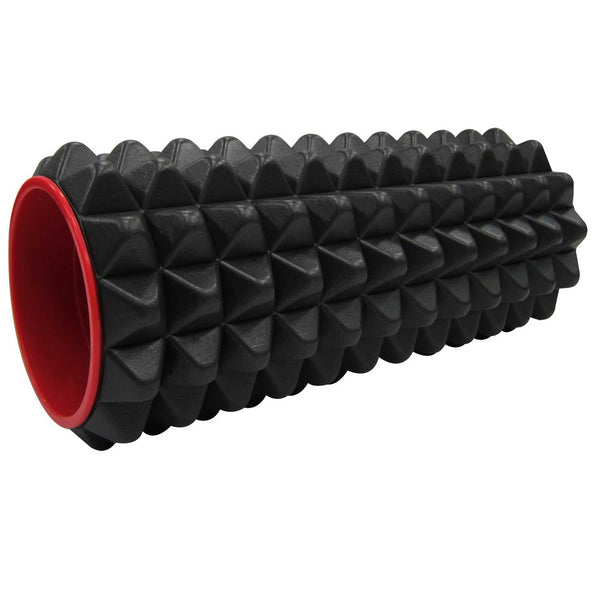
IBF Acupoint Foam Roller · 12"
High-density EVA foam around a solid core that holds its shape. The pyramid-shaped points work like a therapist's thumbs on calves, quads and glutes. At 30.5 cm, it travels easily. $35 CAD.
Shop the roller →HAIBEI Resistance Bands · 3-pack
Three tension levels in red, yellow and green. The lightest for shoulder pass-throughs, the firmer ones for hamstring stretches or a rotator cuff warm-up before your next match.
Shop the bands →Adjust it to your sport
Same eight moves, different priorities.
Tennis
Moves 3 + 8Serves and one-handed backhands put the most load on the upper back, shoulder and forearm. Give those two moves an extra round.
Pickleball
Moves 1 + 5Kitchen play keeps you low for long stretches, so calves and hips take the hit. And warm up before you play: falls are a leading cause of injury.
Padel
Moves 7 + 8Bandejas, viboras and overheads stress the elbow and shoulder, the two most injured areas in the sport.
→ Read also
Want to see what your body is really doing on court? Start with our complete guide to recording your sessions like a pro.
The real test is yours
Soreness rarely comes from nowhere. It usually comes from a habit you can't feel: landing flat after a split step, muscling the ball with your arm instead of rotating, standing too tall at the kitchen.
You won't catch those from memory. You'll catch them on video. Film a session, watch your footwork and your swing, and you'll often find the exact movement your cooldown is cleaning up after.
Stop guessing. Start filming.
Recovery fixes the damage. Video shows you where it comes from. Set the mount up once, and see what your body is actually doing.
Shop the mount →Frequently asked questions
Should I stretch before or after playing?
Both, but differently. Before: dynamic movement like leg swings, arm circles and light rallying. After: the static holds in this routine. Long static holds right before intense play can slightly reduce power for some players.
Is foam rolling supposed to hurt?
It should feel like firm pressure, not pain. If you're holding your breath or tensing up, ease off by putting more weight on your hands or supporting leg.
What if I only have 5 minutes?
Do move 1, move 7 and move 8. Calves, shoulder, forearm. That covers the three areas that take the most repeated load in racquet sports.
Can this routine help with existing elbow pain?
Gentle stretching can feel good, but persistent elbow pain needs a proper assessment. See a physiotherapist before adding load, and check your grip size and string tension too.
Sources
- Roetert EP et al. The biomechanics of tennis elbow: an integrated approach. Clinics in Sports Medicine, 1995.
- Dahmen J et al. Incidence, prevalence and nature of injuries in padel: a systematic review. BMJ Open Sport & Exercise Medicine, 2023;9:e001607.
- The epidemiology of pickleball injuries presenting to US emergency departments, NEISS 2014 to 2023. PubMed ID 40653665, 2025.
- Wiewelhove T et al. A meta-analysis of the effects of foam rolling on performance and recovery. Frontiers in Physiology, 2019;10:376.
This article is general information and doesn't replace advice from a physiotherapist or physician. If pain persists, gets worse, or follows a recent injury, get it checked before stretching.