

How to Analyze Your Tennis Serve (And Actually Improve)
Most players film their serve once, watch it at full speed, decide it "looks weird", and go back to hitting baskets. That isn't analysis. Here is what a coach actually looks at, in what order, and what to do with what you find.
✦ The short version
- Film it properly: side-on from the fence, 120 or 240 fps, 10 to 15 serves per angle
- Watch six frames: stance, peak of the toss, trophy, racquet drop, contact, landing
- Racquet speed comes from rotation, not from arm strength: internal rotation of the upper arm alone accounts for roughly half of racquet head speed
- Fix one cue at a time for three weeks, and measure first serve percentage over 20 serves before and after
If you change three things at once, you won't know which one worked.
The serve is the only shot in tennis where nobody interferes with you, and it's the shot recreational players improve the least. That's not a motivation problem. It's a feedback problem: the motion takes under two seconds, most of it happens behind your head, and what you feel during it rarely matches what you do.
Why hitting more serves doesn't fix your serve
Repetition only improves a motion when it comes with accurate feedback. Without video, you repeat your current pattern and get more consistent at it, faults included. The fastest route is to film a handful of serves, identify a single fault, give yourself one cue for that fault, then film again a few weeks later to check whether the cue actually changed the movement.
What actually creates racquet head speed
Serve speed does not come from a strong arm. It comes from a chain that starts in the legs, moves through the hips and trunk, and finishes with rotation of the upper arm and hand. Knowing which links matter tells you what to look for on your video, and what to ignore.
Internal rotation of the upper arm is the single largest contributor to racquet head speed at impact in a power serve, in a study of high-performance players.
Sprigings, Elliott et al., Journal of Applied Biomechanics, 1994
Flexion of the hand comes next, with horizontal flexion and abduction of the upper arm adding around 13%. That's why a locked, "pushing" arm caps your speed.
Same study
Reviews of serve velocity converge on the same contributors: leg drive and knee extension, hip and trunk rotation, elbow extension, shoulder internal rotation and wrist flexion.
Int. Journal of Sports Physiology and Performance, 2022
Players with more effective knee flexion and extension in the service action show lower loading at the shoulder and elbow. Leg drive is a power source and a joint-protection strategy.
Elliott, British Journal of Sports Medicine, 2006
Stop judging your serve by how hard it looks. Judge it by whether the chain fires in order: legs, then trunk, then arm. A serve that looks smooth and lands soft usually has a broken sequence, not a weak arm.
How to film your serve so the video is usable
Set the phone at roughly hip to shoulder height, on the fence, and keep the whole body plus the peak of the toss inside the frame. Shoot 120 or 240 frames per second, film first and second serves separately, and record 10 to 15 of each. Two angles per session is plenty.
| Angle | What it shows | Best for |
|---|---|---|
| Side on, from the fence | Knee bend, trunk tilt, racquet drop, contact height, landing inside the court | Your first angle, and the one to keep long term |
| Behind, along the baseline | Toss placement relative to the body, shoulder turn, swing path across the ball | Diagnosing slice, kick and directional control |
| Front, from the net side | Toss height and line, shoulder over shoulder rotation, vertical extension | Toss consistency work |
Setup in under a minute: mount, angle, slow motion.
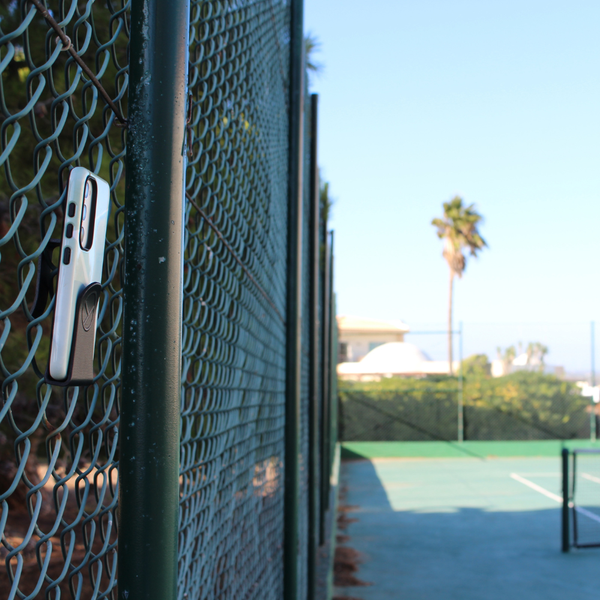
Racquet View phone mount
Clips to a fence or net post in a few seconds and holds the phone steady, so your side-on angle is identical from week to week. Comparable footage is what makes progress visible.
Shop the mount →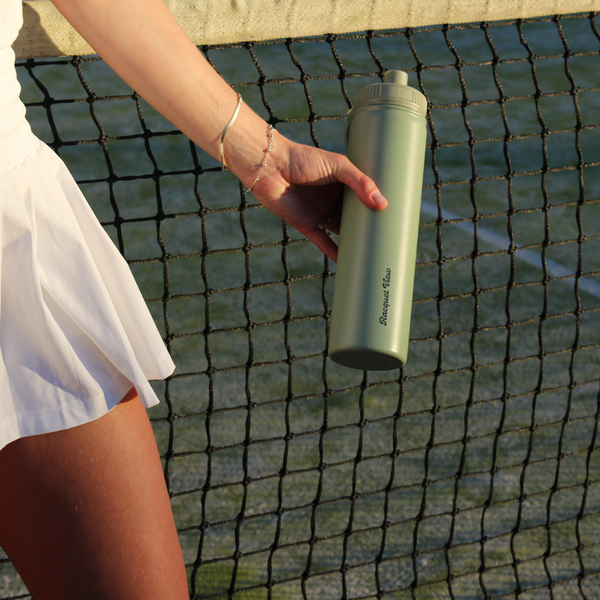
Phone Holder Water Bottle
A vacuum-insulated 25 oz bottle with a built-in magnetic mount, MagSafe compatible and tall enough to give a usable filming angle. For courts where there is no fence or net post within reach.
Shop the bottle →The six frames a coach looks at
Scrub through your clip and pause on these six moments, in this order. Each one tells you something the next one can't.
Stance and alignment
- Look for: feet roughly shoulder width, front foot angled toward the net post, weight settled and still
- Common fault: feet square to the baseline, which blocks the shoulder turn before the serve even begins
- Grip check: pause on the hand. A forehand-style grip forces a flat, armed serve and makes pronation impossible
Continental grip, and point the front toe at the net post. If those two are wrong, nothing downstream can be fixed.
The toss
- Look for: the tossing arm straight and lifted high, the ball peaking slightly above your contact point rather than well above it
- Placement: flat serve slightly in front and to the hitting side, slice further to the side, kick further back over the head
- Consistency test: freeze the peak frame on five serves and compare the ball's position against the fence line behind it
A toss you have to chase is a toss you'll never time. Fix placement before you touch anything else in the motion.
Leg drive and the trophy position
- Look for: knees bent, hips pushed slightly toward the court, back shoulder lower than the front one
- Common fault: straight legs, which removes the first link of the chain and pushes the workload onto the shoulder
- Also check: the racquet edge, not the palm, facing the sky
Load down to go up. Think of the bend as the start of the swing, not as a pose to hold.
The racquet drop
This is the frame most recreational players have never seen of themselves, and the one that separates a serve that snaps from a serve that pushes.
- Look for: the racquet head dropping down the back, elbow up, forearm relaxed
- Common fault: the waiter's tray, palm up under the ball, no drop at all
- Why it matters: the drop is what sets up internal rotation, which is roughly half your racquet speed
Loose grip pressure, around a 4 out of 10. A tight hand cannot let the racquet fall.
Contact point and pronation
- Look for: arm fully extended, contact above and slightly in front of the head, body still rising
- Pronation check: one or two frames after contact, the strings should have turned outward on their own
- Common fault: contact behind the head, which drops both speed and the margin over the net
Don't force the wrist. Pronation is the result of a loose arm rotating, not a movement you add at the end.
Landing and follow-through
- Look for: landing on the front foot inside the baseline, back leg kicking back for balance
- Common fault: landing on the same spot you started, a sign the legs never drove up and forward
- Finish: the racquet decelerating across the opposite side of the body, not stopping abruptly
Where you land tells you what your legs did. It's the easiest frame to read and the most honest.
Serve fault diagnostic table
Match what you see on court to the frame that usually explains it.
| Symptom | Usual cause | Where to look |
|---|---|---|
| Serves land long | Contact behind the head, body leaning back | Frames 02 and 05 |
| Serves land in the net | Toss too low or too far in front, arm not extended at contact | Frames 02 and 05 |
| No pace despite effort | No racquet drop, arm pushing instead of rotating | Frame 04 |
| Shoulder sore after serving | Straight legs, all the load taken by the arm | Frame 03 |
| Second serve sits up | Toss placed for a flat serve, swing path going through the ball instead of up and across it | Frames 02 and behind angle |
| Inconsistent from day to day | Toss placement varying serve to serve | Frame 02, five serves compared |
How to fix one thing at a time
Pick the earliest fault in the chain, not the most visible one. A bad toss makes every later frame look bad, so correcting contact before correcting the toss is wasted work. Then run a three-week block: one cue, every session, filmed weekly.
- Baseline: hit 20 first serves, log how many land in, and save the video
- Block: three weeks, one cue only, written at the top of your journal page
- Retest: same 20 serves, same angle, same phone position, then compare the two clips side by side
- Then move on: next fault in the chain, never two at once
Racquet View video analysis
Send a short clip of your serve and get it read for you: what to correct first, what already works, and drills matched to your level. Useful when your video shows something is off and you can't name it.
Get your serve analyzed →→ Keep the thread
A cue you forget by the next session isn't a correction. Write it down after every practice: here's the method for tracking your progress, and the Tennis Progress Journal built around it.
Frequently asked questions
How many serves should I film?
Ten to fifteen per angle, first and second serves separately. Fewer than that and you will analyze one odd swing instead of your actual pattern. Film the same thing again three weeks later for comparison.
What frame rate do I need to analyze a serve?
120 frames per second is enough to see the toss, the racquet drop and the landing. 240 fps helps at contact, where the racquet moves fastest. Standard 30 fps video will blur the exact moment you most want to inspect.
What is the most common serve fault in recreational players?
The waiter's tray: the palm faces the sky in the trophy position, the racquet never drops behind the back, and the arm pushes the ball forward instead of swinging up through it. It caps racquet speed and strains the shoulder.
Where should the ball toss land?
For a flat serve, slightly in front of the baseline and a little to the hitting side, so you are moving into the court at contact. For slice, further to the hitting side. For kick, further back and over the head. A toss that changes every serve is the fault to fix first.
How long before I see a change in my serve?
Expect three to six weeks per correction if you work one cue at a time and film it every week. Trying to fix the toss, the knees and the wrist in the same session usually changes nothing.
Sources
- Sprigings E., Marshall R., Elliott B., Jennings L. Contributions of upper limb segment rotations during the power serve in tennis. Journal of Applied Biomechanics, 1994.
- Determinant physical factors of tennis serve velocity: a brief review. International Journal of Sports Physiology and Performance, 2022;17(8):1159-1169.
- Elliott B. Biomechanics and tennis. British Journal of Sports Medicine, 2006;40(5):392-396.
Technical cues here are general coaching guidance. Persistent shoulder or elbow pain when serving deserves an assessment before you add volume.