

Your coach fixes your forehand. You forget by Thursday
Your coach corrects you on Tuesday. By Thursday, half of it is gone. Two months later you're still working the same backhand, with the same feeling of going in circles.
✦ The short version
What makes players improve isn't writing a lot. It's writing three things, every time:
- Before the session: one goal about execution, not about results
- After the session: what worked, what didn't, in five minutes
- Every week: reread your notes for ten minutes and pick next week's theme
Paper or digital doesn't matter much. What matters is that it's written down somewhere and actually reread.
Most recreational players train by accumulation: show up, hit, hope it sinks in. That works for a while, then it plateaus. A tennis journal, whether it's a paper notebook or a digital session log, is what turns that accumulation into training.
The difference between an hour on court and an hour of training is intention before and reflection after. A structured journal is simply the cheapest way to force both, in a handful of minutes.
Does keeping a tennis journal actually work?
Yes, with a caveat. No study has tested a tennis notebook on its own. What is well established is the mechanism a journal supports: setting a goal you control, tracking whether you hit it, and evaluating yourself afterward. Across sport psychology and behaviour research, that loop produces large, repeatable performance gains.
The topic is badly quoted online, so here are four solid findings with their sources.
The effect of process goals (what you execute) on sport performance. Outcome goals, the kind you can't fully control, come in at d = 0.09.
Williamson et al., Int. Review of Sport & Exercise Psychology, 2024
Experimental studies, nearly 20,000 participants: monitoring your progress improves goal attainment, and the effect is stronger when the information is physically recorded.
Harkin et al., Psychological Bulletin, 2016
Writing by hand forces you to reformulate instead of transcribe. Across three experiments, handwritten note takers understood the material better than laptop typists.
Mueller & Oppenheimer, Psychological Science, 2014
Protocols built on self-regulation, meaning plan, execute, then evaluate yourself, produced the largest performance gains in the entire review.
Williamson et al., 2024
You'll see numbers like "30% faster progress" or "92% of coaches recommend it" floating around. None of them trace back to a real study. The truth is more useful anyway: the journal isn't what makes you better, the goal, execution and self-evaluation loop is. The journal is just the simplest way to keep that loop running.
How to keep a tennis journal: the three-step method
Write one executable goal before you play, five minutes of notes right after the session, then reread the week's entries for ten minutes and pick a single theme for the week ahead. That is the whole system: under fifteen minutes a week, on paper or in a digital practice log.
What goal to set before a session
"Play better" isn't a goal. "Win" isn't either, because it doesn't depend only on you. A good goal describes something you fully control and can check at the end.
- Weak: work on my serve
- Strong: toss to the same spot on every first serve
- Weak: be more aggressive
- Strong: take one step inside the baseline on every second serve return
One goal per session. Not three. Three goals is the same as no goal: your attention scatters by the third game.
What to write in your tennis journal after a session
The best moment is on the bench, before you pack your racquet. Once you're in the car, the details are gone. The template below fits on one page and works for a solo practice or a match.
- Context: date, location, session type, surface, opponent
- Goal of the day: hit, partly hit, missed
- What worked: one specific thing, not "good energy"
- What didn't: the fact, not the verdict. "Crosscourt backhand landing short", not "terrible backhand"
- Self-evaluation: confidence, focus, intensity, footwork, out of 5
- Free note: coach feedback, a tactical sketch, how your body felt
Don't turn your journal into a courtroom. A note that describes a fact gives you something to work on. A note that judges you just gives you a bad evening.
How to review your notes each week
This is the step almost everyone skips, and it's the one that produces the gains. Read your last three or four sessions in one sitting and look for what repeats.
- The pattern: which problem shows up in three sessions out of four
- The cause: technique, footwork, decision making or fatigue
- The plan: the single theme for the week ahead
- For your coach: the two points to bring up at your next lesson
Showing up with "my forehand sails long when I'm moving backward" beats "things feel off lately" by a mile. Same lesson fee, far sharper hour.
Paper or digital tennis journal: which should you choose?
Choose paper if you want the reflection itself to be better: writing by hand forces you to reformulate instead of copy a phrase, and a notebook never runs out of battery in your racquet bag. Choose digital if speed, keyword search and sharing with a coach matter more. Both work, and many players run both.
| Paper | Digital | |
|---|---|---|
| Effect on reflection | Stronger: writing by hand forces you to reformulate | Fast, but invites copy-paste phrasing |
| On court | Always in the bag, no battery | Depends on your phone and its charge |
| Rereading | Flip through a season in two minutes | Keyword search |
| Sharing with a coach | Photo of the page | Instant |
| Best for | Competitors, club players, weekly lessons | Starting without buying anything, players on the move |
Plenty of players run both: a digital practice log for a quick note between games, a paper notebook for the Sunday reread.
The Racquet View digital journal
Same structure as the paper version, open on any device. It's the simplest way to test the habit before buying anything at all.
Open the free journal →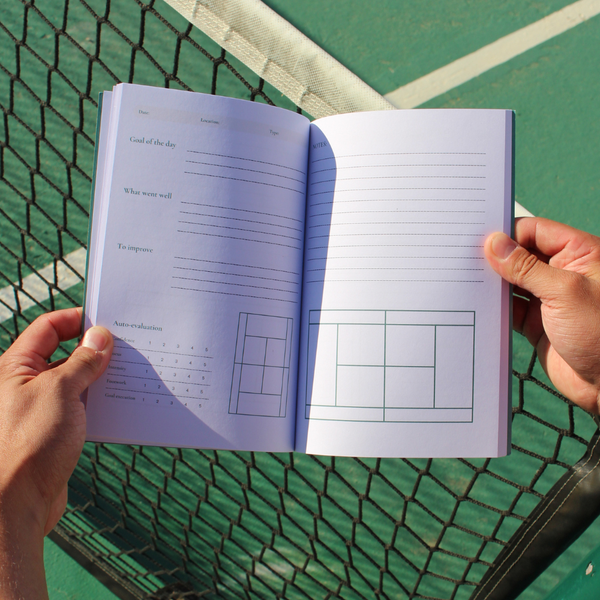
Tennis Progress Journal · $22 CAD
35 guided sessions built on exactly this method: goal of the day, what went well, what to improve, and a self-evaluation on confidence, focus, intensity, footwork and goal execution. Compact enough for a racquet bag, soft-touch cover, free shipping.
Shop the journal →"This journal keeps me accountable and focused every time I train. I finally feel like I'm moving forward with a purpose."
Camille · UTR 4→ Tested by Florida Tennis Magazine
Osvaldo Godoy and Alex Binstok reviewed the journal alongside the mount and landed on the same problem this article describes: a coach gives you a correction in practice, and a week later it's gone. They also singled out the guided layout and the court diagram for organizing what to work on next. Read their review.
→ Read also
A journal captures what you felt. Video captures what actually happened. Together they're hard to beat: start with our complete guide to recording your sessions like a pro.
How to stick with a training notebook past week three
Attach the writing to something you already do, keep the entry to five lines, and accept missed sessions without restarting from zero. Starting is never the problem. Continuing once the novelty fades is, and every fix below is about lowering the cost of a single entry.
- Anchor it to something you already do: write before you untie your shoes, not "later"
- Keep it short: five lines you'll actually write beat a page you won't
- Allow gaps: one skipped session cancels nothing, just pick it up at the next one
- Keep it visible: the journal lives in the racquet bag, never on a shelf at home
Start with one session
Not a season, not a system. One session: a goal before, five minutes of notes after. You'll see the difference at your first weekly reread.
Try the free journal →Frequently asked questions
How long does keeping a tennis journal really take?
One minute before the session, five minutes after, and ten minutes a week for the review. If you go past that, you are writing too much and you will quit within a month.
Should I log matches or only practice sessions?
Both, but differently. In practice you log execution, meaning the one thing you were trying to do. In matches you log decisions: which patterns worked, when you changed plans and why.
Is a tennis journal worth it if I only play once a week?
Even more so. The less you play, the more forgetting between sessions costs you. A practice log bridges the gap so each session starts where the last one ended.
What should I write in a tennis journal after a session?
Six things: context, the goal of the day and whether you hit it, one thing that worked, one thing that did not, a self-evaluation on confidence, focus, intensity and footwork, and a free note for coach feedback.
Paper or digital tennis journal: which is better?
Paper wins on reflection because writing by hand forces you to reformulate, and it never runs out of battery. Digital wins on speed, search and sharing with a coach. Many players use both.
Sources
- Williamson O. et al. The performance and psychological effects of goal setting in sport: a systematic review and meta-analysis. International Review of Sport and Exercise Psychology, 2024;17(2):1050-1078.
- Harkin B. et al. Does monitoring goal progress promote goal attainment? A meta-analysis of the experimental evidence. Psychological Bulletin, 2016;142(2):198-229.
- Mueller P. A., Oppenheimer D. M. The pen is mightier than the keyboard: advantages of longhand over laptop note taking. Psychological Science, 2014;25(6):1159-1168.