

Why tennis players wear arm sleeves?
For years, a sleeve on a tennis court meant one thing: someone was hurt. Then two of the best players in the world kept theirs on after they healed. Here's what an arm sleeve actually does, what it doesn't, and why it became part of the look.
✦ The short version
- Compression: a modest but real effect on soreness and strength recovery, strongest after the session, not during
- UV protection: a UPF 50 sleeve blocks about 98% of UV rays, doesn't sweat off, and never needs reapplying mid-match
- Style: Alcaraz and Sinner turned a medical accessory into a signature detail
- What to buy: UPF 50+ as a printed number, a snug fit, a silicone grip band, and a thin wicking fabric
It's not a treatment for tennis elbow. It's a comfort, recovery and sun tool, and a pretty good one.
 Why top tennis players started wearing an arm sleeve
Most pro sleeves started as injury management and stayed for comfort and confidence. The two most visible examples on tour are also the two biggest names in the men's game.
Carlos Alcaraz: the physio's call
After a right forearm injury in training forced him out of Monte Carlo and Barcelona, Alcaraz returned in Madrid wearing a compression sleeve on his hitting arm. He explained in his press conference that he wore it on his physiotherapist's advice, openly admitting he didn't fully understand how it worked.
By Roland-Garros a few weeks later, the pain was fading and the sleeve had become more of a precaution than a necessity. He kept it on, and went on to win the title.
One of the best players in the world wore it for reassurance as much as for physiology. Confidence in your arm is part of how freely you swing.
Jannik Sinner: from injury to identity
Sinner hurt his elbow in a fall during his Wimbledon 2025 match against Grigor Dimitrov, then played the rest of the tournament in a white compression sleeve on his arm. He was still wearing it in the final, which he won against Alcaraz.
Everyone assumed it would disappear once the elbow healed. Instead, it stayed, and in 2026 it's become a recognizable part of his on-court look alongside his cap.
The sleeve made the jump from medical gear to style signature, the same way it did in basketball two decades earlier.
What compression actually does for your arms
Compression garments apply steady external pressure to the muscle. The research shows a modest but consistent benefit for recovery: less soreness and a faster return of strength and power in the day or two after hard exercise. It is not a performance enhancer during play, and it doesn't heal an injured tendon.
Compression garments moderately reduced delayed-onset muscle soreness in a meta-analysis of 12 studies, with similar effects on strength (0.46) and power (0.49) recovery.
Hill et al., British Journal of Sports Medicine, 2014
Studies pooled in a second meta-analysis: compression helped recovery most after resistance-type exercise, with the clearest effects beyond 24 hours.
Brown et al., Sports Medicine, 2017
Of the sun's UV rays blocked by a UPF 50 fabric, which lets through only 1/50th of the radiation. UPF 50 is the minimum for The Skin Cancer Foundation's seal of recommendation.
The Skin Cancer Foundation
Roughly what a plain white cotton T-shirt offers, and even less once it's wet with sweat. Your usual tennis shirt is weaker sun protection than most players assume.
Dermatology and sun-safety sources
Most compression research was done on legs and whole-body garments. One study on the upper arm found that 12 hours of wearing a compression sleeve wasn't enough to speed up recovery of a damaged muscle. So think of an arm sleeve as a comfort and recovery aid, worn during play and for a while after, not a magic fix.
Where compression helps a racquet player
- Warmth: keeps the forearm muscles warm between points and in cool evening sessions
- Feel: many players report a steadier, more "held" forearm, which is what Alcaraz's physio was after
- After play: the recovery benefits in the research show up in the 24 to 48 hours after hard exercise
- Not a cure: ongoing elbow pain is a job for a physio, plus a check of grip size and string tension
UV protection: the benefit most players underrate
A tennis match puts your forearms in direct sun for one to three hours, often at midday, on a hard court that reflects light back up at you. Sunscreen sweats off and needs reapplying every two hours, which almost nobody does between sets. A UPF 50+ sleeve blocks about 98% of UV on the skin it covers, and it keeps working until you take it off.
| UPF 50+ sleeve | Sunscreen only | |
|---|---|---|
| Protection level | About 98% of UVA and UVB blocked | Depends on how much you apply, usually too little |
| During a sweaty match | Stays constant | Wears off, needs reapplying every two hours |
| On your grip | Nothing on your hands | Can make the handle slippery |
| Watch out for | Overstretched fabric lets more UV through | Missed spots, forgotten reapplication |
The best approach is both: sleeves on the arms, sunscreen on everything they don't cover. Dark and bright colours and a dense weave give the best protection, and a sleeve that fits properly beats one stretched thin over your forearm.
Style: how the arm sleeve became a look
Basketball did it first. A sleeve worn for an injury became one of the most copied accessories in the sport, and the same thing is now happening in tennis. What changed is that players stopped hiding it: Sinner's sleeve is as much a part of his image as his cap.
- One arm: the pro look, on the hitting arm, and the natural choice if compression is your main reason
- Both arms: the practical choice for sun protection, especially at summer tournaments
- Colour: white reads clean and classic, black reads bold, and matching your kit is what makes it look intentional
- Fit: a sleeve that sags or bunches looks like a bandage. A snug one with a grip band looks like gear
How to choose an arm sleeve for tennis
- UPF 50+: printed as a number on the label. Vague claims like "sun protective" mean nothing
- Light compression: snug and supportive, never tingling or leaving deep marks
- Measured fit: bicep and forearm circumference, checked against the size chart
- Grip band: a silicone band at the top so it doesn't slide down mid-rally
- Thin, wicking fabric: it should move sweat away, not trap it like cotton does
- Flat seams: nothing that rubs the inside of your elbow over a long match
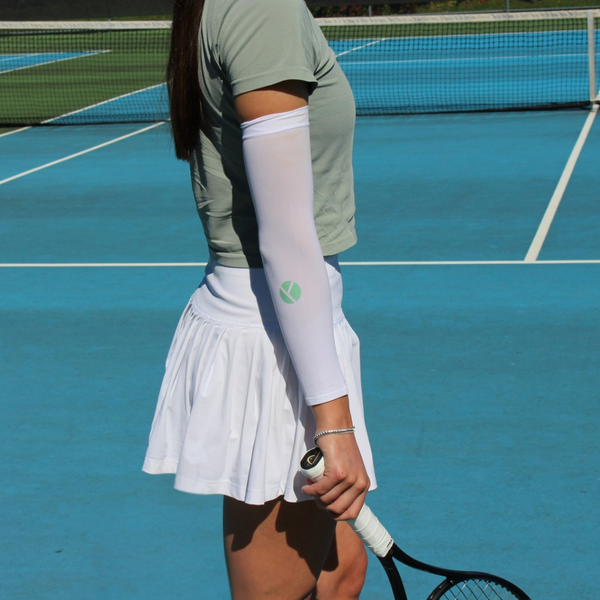
UV Compression Arm Sleeves
UPF 50+ on the forearms, elbows and upper arms, light compression that doesn't restrict your swing, and a quick-drying fabric with a stay-put fit that won't slide mid-rally. Unisex and sold as a pair: one on the hitting arm for the pro look, or both for full sun coverage.
Shop the sleeves →→ Read also
Sleeves help your arm during and after play. The rest of the recovery happens in the twelve minutes after you walk off court: here's the post-match stretching routine, including the forearm stretch that protects your elbow.
Frequently asked questions
Do arm sleeves help tennis elbow?
A compression sleeve can make the forearm feel warmer and more supported, and many players like it during a flare-up. It does not treat the tendon. Persistent elbow pain needs an assessment, plus a look at grip size, string tension and technique.
Should I wear one sleeve or two?
For compression, most players wear one on the hitting arm, like Alcaraz and Sinner. For sun protection, wear two: UV hits both arms, and one sleeve leaves the other forearm exposed for the whole match.
What UPF rating should a tennis arm sleeve have?
Look for UPF 50+, printed as a number on the label. UPF 50 blocks about 98% of UV rays, and it is the minimum rating for The Skin Cancer Foundation's seal of recommendation. Skip anything labelled only 'sun protective'.
Do arm sleeves make you hotter?
A thin, moisture-wicking sleeve often feels cooler than bare skin in direct sun, because it shades the arm and spreads sweat for evaporation. A thick or cotton sleeve does the opposite. Fabric and fit matter more than the idea of a sleeve.
How tight should a compression arm sleeve be?
Snug without leaving deep marks or tingling. Measure your bicep and forearm and follow the size chart. A sleeve that is too tight overstretches the fabric, which also reduces its UV protection.
Sources
- Hill J. et al. Compression garments and recovery from exercise-induced muscle damage: a meta-analysis. British Journal of Sports Medicine, 2014;48(18):1340-1346.
- Brown F. et al. Compression garments and recovery from exercise: a meta-analysis. Sports Medicine, 2017;47(11):2245-2267.
- Cerqueira M. S. et al. Twelve hours of a compression sleeve is not enough to improve the muscle recovery of an exercise-damaged upper arm. Apunts Medicina de l'Esport, 2015;50:23-28.
- The Skin Cancer Foundation. Sun protective clothing. skincancer.org.
- Canadian Skin Cancer Foundation. Sun protection clothing. canadianskincancerfoundation.com.
- Press coverage of Carlos Alcaraz at the Mutua Madrid Open and Roland-Garros 2024, and of Jannik Sinner at Wimbledon 2025.
This article is general information. If you have ongoing arm or elbow pain, see a physiotherapist before relying on any support product.